Understanding Key Banking Instruments: SBLCs, BGs, and DLCs
Understanding Key Banking Instruments: SBLCs, BGs, and DLCs in the world of trade finance, is the key to a winning strategy to for your business. However, businesses often rely on various financial instruments to secure deals, mitigate risks, and ensure payment security. Three of the most commonly used instruments are Standby Letters of Credit (SBLCs), Bank Guarantees (BGs), and Documentary Letters of Credit (DLCs). There are more, but these are the most common so we will focus on these for now. While each serves a similar purpose—facilitating trust between parties—they differ in their structure, usage, and application processes.
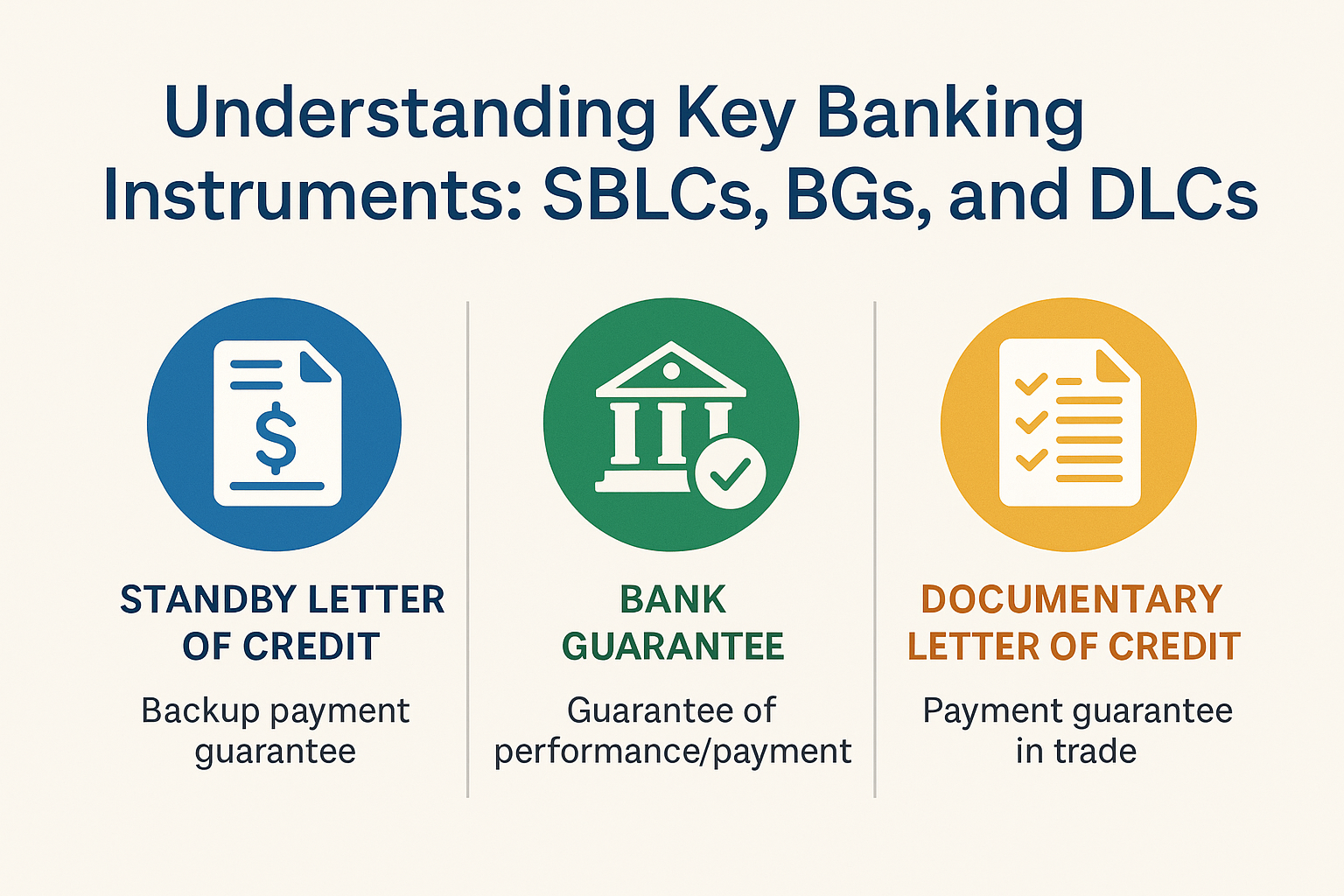
Standby Letter of Credit (SBLC)
A Standby Letter of Credit (SBLC) is a financial instrument that provides a guarantee of payment in case a party fails to meet its contractual obligations. Typically used in international trade, the SBLC is not intended for immediate payment but acts as a backup to secure the terms of a contract.
Key Uses:
- Payment security for contracts, including performance or lease obligations
- Protection against non-performance or failure to pay
- Commonly used in construction projects, government contracts, and international trade
Process for Issuance:
- Define the Transaction: Clear details about the transaction need to be provided, including the amount, currency, and who the beneficiary is.
- Application Submission: The bank requires various documents, including company registration, identification of authorized signatories, and details of the beneficiary.
- Credit Review & Collateral: The bank evaluates your creditworthiness and may require collateral.
- Legal Drafting & Issuance: A legal draft is created based on internationally recognized formats (ISP98 or UCP600).
- SWIFT Transmission: Once issued, the SBLC is transmitted via SWIFT to the beneficiary’s bank.
Bank Guarantee (BG)
A Bank Guarantee (BG) is a promise by a bank to cover a loss if a borrower defaults on a loan or fails to meet certain obligations. BGs are commonly used to provide reassurance to the beneficiary that they will be compensated in case of non-performance by the applicant.
Key Uses:
- Secures payment or performance obligations in domestic and international trade
- Used in large-scale contracts, including construction, leasing, and procurement
- Often required in banking and lending to protect the lender’s interest
Process for Issuance:
- Transaction Definition: The bank needs clarity on the specific obligation being guaranteed.
- Application & Collateral: Similar to SBLCs, banks require financial documentation and may request collateral.
- Credit Assessment: The bank evaluates the creditworthiness of the applicant and the terms of the guarantee.
- Issuance & Transmission: Once the guarantee is approved, it is issued to the beneficiary via SWIFT or in physical form.
Documentary Letter of Credit (DLC)
A Documentary Letter of Credit (DLC) is an irrevocable guarantee from a bank that payment will be made to the seller as long as the terms of the letter are met. Unlike SBLCs, DLCs are used primarily in trade transactions to ensure the buyer’s payment commitment.
Key Uses:
- Ensures payment in international trade transactions
- Used in situations where the buyer and seller are in different countries with limited trust
- Typically used for commodity transactions, imports/exports, and large trade deals
Process for Issuance:
- Agreement and Application: The buyer and seller agree on terms and the buyer submits an application to the bank.
- Drafting the DLC: The bank drafts the letter, which outlines the conditions for payment, including documents like invoices and shipping receipts. Both parties agree to the terms.
- Transmission to Seller’s Bank: Once the seller meets the terms outlined in the DLC, payment is released.
Comparing SBLCs, BGs, and DLCs: Key Differences
While these instruments serve similar purposes in securing financial transactions, they differ in several key aspects:
| Feature | SBLC | BG | DLC |
|---|---|---|---|
| Purpose | Backup payment guarantee | Guarantee of performance/payment | Payment guarantee in trade |
| Usage | International trade, construction | Contracts, loans, procurement | International trade transactions |
| Triggering Event | Non-performance or failure to pay | Default on obligations | Meeting contract terms (documents) |
| Expiration | Typically fixed, can be extended | Fixed or event-based | Typically tied to trade completion |
| Issuing Bank | Generally commercial banks | Commercial or investment banks | Commercial banks |
Steps to Secure a Bank Instrument: Key Considerations
- Understand Your Transaction Needs: Before applying for any banking instrument, ensure you understand the exact needs of your transaction. Are you securing a payment, performance, or trade guarantee?
- Hire the right team to facilitate: After you thoroughly understand your project needs, but before you engage with the bank, find the experienced team like Business Loan Solutions to help structure the deal and guide you through the process seamlessly.
- Prepare Necessary Documentation: Whether applying for an SBLC, BG, or DLC, you’ll need to prepare company documentation, financial statements, and transaction contracts.
- Compliance and Due Diligence: Expect thorough background checks. Banks will evaluate the creditworthiness, compliance with KYC and AML regulations, and potential risks associated with the transaction.
- Legal Review: Ensure that the terms of the instrument align with your contract and are legally enforceable.
- Track and Monitor: Once issued, monitor the instrument for expiration, amendments, or potential draws to ensure its effectiveness.
Final Thoughts
SBLCs, BGs, and DLCs are powerful tools for businesses seeking to mitigate risks and secure payments. Whether you’re a buyer or a seller, understanding how these instruments work and how to leverage them in the context of your specific transaction is crucial. Always ensure that the transaction and instrument are backed by solid legal and financial structures to maximize their effectiveness.
Take the Next Step in Securing Your Deal
Ready to leverage the power of SBLCs, BGs, or DLCs to secure your next big project or transaction? Contact us today to schedule a consultation and ensure your deal is backed by the right financial instruments. Let’s turn your business plans into successful, protected realities.

Why Do Most Projects Never Get Funded?—And How DealReady™ Changes That Forever
Every day, brilliant business ideas fall flat—not because they lacked potential, but because they weren’t presented the right way. In the fast-paced world of commercial lending and private capital, it’s not enough to have a great project—you have to communicate it with clarity, credibility, and confidence.
And that’s where most founders flounder.
At BLS Funds, we’ve spent years on the front lines of capital, watching founders pour everything into their vision—only to be rejected by lenders and investors without knowing why. We saw the pattern, we saw the pain, and we decided to solve it.
Today, we’re proud to introduce DealReady™—a powerful, AI-enhanced capital intelligence system designed to turn confusion into confidence, and stalled-out deals into fundable opportunities.
💥 The Real Reason Deals Get Rejected
Let’s be honest: most lenders and investors don’t have time to fix broken deals. They receive hundreds of files each month and are trained to say “no” at lightning speed. And they’re not going to coach you on how to fix your documents, improve your story, or restructure your capital ask.
That’s not their job. It’s yours.
The problem? Most business owners, project sponsors, and even consultants don’t know what a lender actually looks for behind closed doors. So they guess. They Google. They piece together templates and hope it’s enough.
It’s not.
And until now, there was no clear, structured, and intelligent way to analyze, improve, and prepare a deal before it landed in front of capital decision-makers.
🚀 Enter DealReady™
DealReady™ is more than just a tool—it’s a capital readiness system.
We combined real-world capital structuring experience with cutting-edge AI-powered document analysis to create a first-of-its-kind service that evaluates, enhances, and elevates your funding package.
Here’s how it works:
- Upload your existing business plan, pro forma, pitch deck, or project summary.
- DealReady™ uses AI to extract key data points and analyze them against lender expectations.
- You receive a custom DealReady Score™ and a concise 1–2 page Capital Readiness Report.
- If your project scores 90 or above, you may be eligible for referral to our trusted lender network.
- If you fall short, you can opt for a Done-For-You upgrade to transform your documents into fundable, lender-ready capital packages.
It’s fast. It’s accurate. And it takes the guesswork out of getting funded.
🔍 What Makes DealReady™ Different?
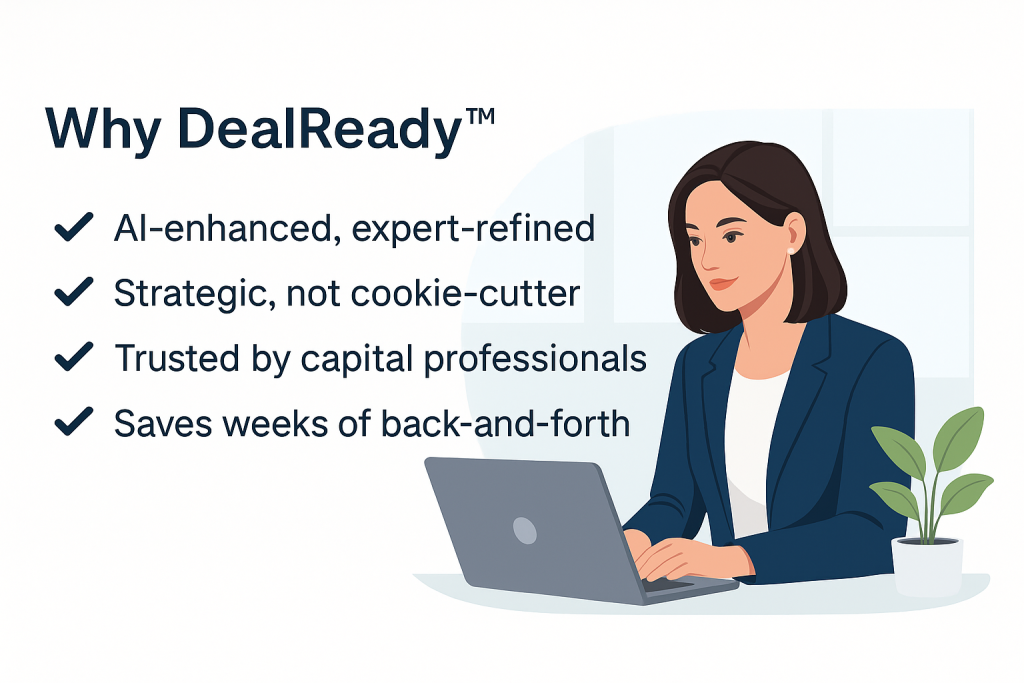
✅ AI-Enhanced, Expert Refined
We don’t rely solely on automation. DealReady™ is powered by a hybrid engine: intelligent software meets decades of boots-on-the-ground capital expertise. Every Deal Score™ reflects the nuances real underwriters look for—packaged in a format that’s easy to understand and act on.
🧠 Strategic, Not Cookie-Cutter
This isn’t a fill-in-the-blank template shop. We assess the actual content, flow, feasibility, and financial logic of your deal. We provide actionable recommendations based on your unique structure—not just generic advice.
🤝 Trusted by Capital Professionals
Family offices, lenders, brokers, and institutional capital partners use DealReady™ to screen inbound deal flow. It saves them time and raises the bar on quality submissions.
⏳ Saves Weeks of Back-and-Forth
No more playing email tag or wondering what a lender meant by “not ready.” You’ll know exactly what’s missing, what’s working, and what to fix—before you waste another month pitching a file that will never get approved.
💡 Who It’s For
- Business Owners & Founders: Tired of rejections without feedback? DealReady™ shows you what lenders see.
- Real Estate Developers: Confused why your capital stack isn’t working? We’ll tell you—and help fix it.
- Brokers & Advisors: Tired of submitting deals that never close? Run them through DealReady™ first.
- Family Offices & Capital Firms: Let us analyze and summarize inbound requests, saving you time and exposing hidden gems.
💼 The Deal Score™: Your Competitive Edge
Each submission receives a proprietary Deal Score™—our internal capital readiness rating that tells you (and us) exactly how close you are to fundable. Scores over 90 are automatically eligible for optional lender introduction and review.
No one else offers this kind of benchmarked, transparent, and honest feedback based on real capital readiness standards.
💬 Why DealReady™ Works
Lenders speak a different language. So we translated your vision into lender speak for you.
DealReady™ isn’t about dressing up bad projects—it’s about giving serious operators the tools, insight, and presentation they need to speak directly to capital and move their deals forward. We built it because we needed it. And now, you get to use it too.
📩 Ready to Get Funded?
If you’ve been spinning your wheels trying to secure financing without knowing why you’re hitting walls, DealReady™ is your new secret weapon.
Start with your messy documents. End with clarity, confidence, and capital alignment.
👉 Visit the DealReady™ page to get started now.


Investors Look Back to Look Forward – Is this a revisit of 2008?
When I look at the state of affairs in today’s economy, I am quickly reminded about the Great Recession in 2008 and subsequent years. It was an impactful time for me personally. I had just left my high paying corporate job to be in commercial real estate full time. I remember thinking, ut oh….what did I just do? You see, even though I had been in real estate almost all of my life, as a newbie in the commercial industry fulltime, I had to learn a thing or two. I went from commercial real estate agent to commercial real estate therapist. I listened to investors who lost everything including $80m in one day, to the boats, cars, houses, wife kids and even the dog moved out. More importantly, I listened, I observed and I learned what not to do. I asked questions from veterans in the industry, what is your strategy to get through the awful financial time? Here’s a culmination of what I learned.
- Diversification is Key: One of the most significant lessons from 2008 is the importance of diversifying investment portfolios. Relying solely on one market or property type can expose investors to heightened risks during a downturn. Spreading investments across different assets and locations can act as a safety net during economic upheaval.
- Avoid Overleveraging: The 2008 recession demonstrated the dangers of excessive borrowing and leverage. Maintaining a reasonable debt-to-equity ratio helps investors weather the storm during economic downturns, preventing foreclosure risks and financial strain.
- Research Market Fundamentals: Understanding the local market dynamics is crucial for making informed investment decisions. Pay attention to factors such as job growth, population trends, and infrastructure development, as these elements can impact property demand and rental income stability.
- Prepare for Volatile Markets: Recessions often lead to volatile markets. Being prepared for fluctuations in property values and rental rates enables investors to react swiftly and adjust strategies to minimize potential losses.
- Cash Reserves are Lifelines: Maintaining sufficient cash reserves acts as a buffer during challenging times. Having readily available funds allows investors to cover operating costs, mortgage payments, and take advantage of new opportunities that may arise amidst the downturn.
- Long-term Vision Trumps Short-term Gains: During periods of economic uncertainty, it’s crucial to adopt a long-term investment perspective. Avoid speculative investments driven solely by short-term gains and focus on properties with stable income potential and enduring value.
- Adaptability and Flexibility: In times of recession, markets shift, and investor preferences change. The ability to adapt and be flexible with investment strategies is crucial to surviving and thriving in a changing economic landscape.
- Analyze and Stress Test Investments: Before committing to a real estate investment, thoroughly analyze the property’s financials and stress test them against different economic scenarios. This process can help identify potential vulnerabilities and allow for appropriate risk mitigation measures.
- Consider Contrarian Investing: Opportunities often emerge during economic downturns, and contrarian investing involves going against the prevailing market sentiment. Identifying undervalued properties with strong growth potential can lead to substantial returns when the market rebounds.
- Learn from Past Mistakes: Lastly, one of the most valuable lessons from 2008 recession is to learn from past mistakes. Analyze what went wrong during the downturn, both on a macroeconomic level and in individual investment decisions. This retrospective evaluation can help investors refine their strategies and build resilience for the future.
While we know that this is not a repeat of 2008, this economic downturn will The upcoming recession may present challenges for real estate investors, but it also offers valuable opportunities for growth and learning. By reflecting on the lessons from the 2008 crisis and applying them to today’s market, investors can position themselves to make informed and prudent decisions. Remember, knowledge, adaptability, and careful planning are the cornerstones of recession-proof real estate investing.
These are lessons from 2008 that my clients learned and I learned through them. As always, we are here to answer your specific questions and help provide a guide when it feels like things are going sideways. Call us at 813-995-9595. We got your back.
INVESTORS: How to avoid financial ruin in CRE deals…
Nearly 65% of investors in CRE do not know when their loans are due. As we navigate through the dynamic economic landscape of today, waiting for the bank to call and renew your loan is too late. With increasing interest rates for longer, understanding and leveraging information in the finance industry becomes more crucial than ever. Our commitment to guiding investors in safeguarding their capital and real estate investments remains unwavering. It’s disheartening to witness the impact of bankruptcy and foreclosures on investors, often resulting from manageable circumstances. To assist you in thriving in the commercial real estate market while avoiding financial pitfalls, here are a few strategies:

- Conduct thorough due diligence on your CRE loans and promissory notes. Many investors overlook the importance of in-depth analysis of their financial instruments. It’s essential to conduct comprehensive research on your portfolio to identify the history of your loans, including previous ownerships and payments. Surprisingly, some loans might be prepaid, which could reveal untapped equity in properties you’re involved with. This equity, once identified, can significantly enhance your investment strategy. Our expertise lies in uncovering these opportunities, providing a unique advantage to our clients.
- Secure your REEIP Trust Claim(s). A significant number of properties are likely eligible for a REEIP (Real Estate Equity and Interest Protection) Trust claim, largely due to overlooked or misunderstood financial transactions by banks. Identifying such scenarios can lead to reclaiming equity lost in previous transactions, essentially recovering value that rightfully belongs to you. This process is directly linked to thorough due diligence and understanding the nuances of your property’s financial history.
- Property Tax Adjustments. As property values begin to decline, especially highly valued commercial real estate, the local assessors office may keep the high valuation on record, thereby keeping your tax bill high. In order to change the valuation, you need to appeal the value with the property assessors office. This doesn’t happen over night, so do not wait until October 31st to begin the paperwork.
- Changing market trends and valuations. In today’s volatile market, it is also vital to keep abreast of changing regulations and market trends that can affect real estate values and investment viability. For instance, understanding the impact of interest rate changes, economic downturns, or legislative shifts can provide investors with a strategic edge, allowing for proactive adjustments to investment strategies. Additionally, leveraging technology and analytics can offer deeper insights into market conditions, property valuations, and investment opportunities, enabling more data-driven decision-making.
- Network of knowledgeable professional. Moreover, building a network of knowledgeable professionals, including real estate agents, attorneys, and financial advisors, can be invaluable. These relationships can provide you with access to insider knowledge, advice on complex legal and financial issues, and opportunities that may not be widely known to the public. Engaging with the community and participating in real estate forums and seminars can also enhance your understanding and strategies within the industry.
- Sell Now and live to invest another day. Finally, selling your commercial real estate portfolio can help mitigate risks associated with market volatility, especially if your loans are due in the next 5 years. Conversely, investing in different types of properties, such as residential, commercial, and industrial, or in various geographic locations, can spread risk and increase the potential for steady returns.
- Sustainable, Energy, and Government. If you need to hold on, now is a great time to invest in SEG programs that will reduce your carbon footprint and will increase the future value for when the commercial real estate market does return. Embracing sustainability and considering environmental impacts when making investment decisions can also appeal to a broader market, potentially increasing property values and attractiveness to tenants and buyers.
The path to success in real estate investment is multifaceted and requires a holistic approach that encompasses market analysis, due diligence, and continuous learning. By adopting these strategies, investors can not only avoid common pitfalls but also position themselves for long-term growth and success in the ever-evolving real estate market.
Investing in commercial real estate is a complex endeavor that requires a blend of knowledge, diligence, and access to the right information and resources. By staying informed about the financial mechanisms at play within the real estate industry, investors can make more informed decisions, navigate challenges more effectively, and unlock new opportunities for growth and stability.
We have seen a few downturns and we are here for you to answer questions, provide guidance and help navigate these unknown and challenging times. Call us at 813-995-9595.

Bridge loan terms tailored to meet your needs…
Bridge loan terms tailored to meet your needs..
Commercial real estate investors today are often asset rich but temporarily liquidity poor and need to access capital quickly in order to take advantage of a time-sensitive situation. Bridge loan terms tailored to meet your needs is your solution.
WE CAN CLOSE In as little as 5 days! We put our borrower’s needs first. We care about what you care about. We’ll create loan terms tailored to meet your individual needs.


About Business Loan Solutions
It is a long established fact that the business of lending money is ever changing. As a business owner or investor, you need to consult with an expert, someone on your side to navigate the lending options from the BEST lenders in the market.
Unlocking Hard Money Loans for Rental Properties
Are you an aspiring real estate investor looking to enter the rental property market but facing challenges in securing financing? Look no further—hard money loans may just be the solution you need. In this comprehensive guide, we will delve into the intricacies of hard money loans for rental properties, providing you with valuable insights on how to successfully secure funding and surpass the competition.
Understanding Hard Money Loans
In the realm of real estate investment, hard money loans have emerged as a popular choice for financing rental property acquisitions. Unlike traditional loans offered by banks or credit unions, hard money loans are typically provided by private investors or companies. These loans are asset-based, with the property itself serving as collateral, making them an attractive option for investors who may not meet the stringent criteria set by conventional lenders.
The Advantages of Hard Money Loans
- Efficient Approval Process: Compared to traditional loans, hard money loans offer a significantly faster approval process. Private lenders prioritize the property’s value and potential profitability over the borrower’s credit history. As a result, the loan application and approval process can be expedited, allowing investors to capitalize on time-sensitive investment opportunities swiftly.
- Flexible Terms: Private lenders have greater flexibility in structuring loan terms. This can be advantageous for real estate investors who require tailored repayment schedules or terms that align with their specific investment strategies.
- Accessibility: Hard money loans are accessible to investors with lower credit scores or those who may have difficulty qualifying for traditional financing options. Since the loan is primarily based on the property’s value, borrowers with less-than-ideal credit can still secure funding.
- Collateral-Based Security: With hard money loans, the property being purchased serves as collateral, minimizing the lender’s risk. In the event of default, the lender can recover their investment by selling the property. This collateral-focused approach allows borrowers with unconventional financial situations to secure funding.
Tips for Successfully Securing Hard Money Loans for Rental Properties
1. Research and Identify Reputable Lenders
Conduct thorough research to identify reputable hard money lenders specializing in financing rental properties. Look for lenders with extensive experience in the real estate market and a proven track record of successfully funding similar projects. Reading reviews, seeking recommendations from fellow investors, and actively participating in industry events can help you find reliable lenders.
2. Develop a Solid Business Plan
To enhance your chances of securing a hard money loan, develop a comprehensive business plan that effectively showcases the investment potential of the rental property. Include key information such as the property’s location, market demand, projected rental income, and your detailed strategy for managing and maintaining the property.
3. Gather Required Documentation
Prepare all the necessary documentation to support your loan application. This typically includes detailed property information, financial statements, credit reports, proof of insurance, and any additional documents requested by the lender. By providing a complete and well-organized package, you demonstrate professionalism and dedication to the investment opportunity.
4. Highlight Real Estate Experience
If you possess prior experience in real estate investing, make sure to highlight it during the loan application process. Demonstrating a successful track record can instill confidence in lenders and significantly increase your chances of loan approval.
5. Negotiate Favorable Loan Terms
While hard money loans often come with higher interest rates and fees compared to traditional loans, there is room for negotiation. Carefully review the proposed loan terms and engage in open discussions with the lender to identify areas where more favorable conditions can be achieved. Building a strong rapport and working closely with the lender can lead to a mutually beneficial agreement.
In Conclusion
Hard money loans offer a valuable financing option for real estate investors venturing into the rental property market. With their quick approval process, flexible terms, accessibility, and collateral-based security, these loans provide the necessary financial support to kickstart your investment journey. By conducting thorough research, developing a solid business plan, gathering the required documentation, highlighting your real estate experience, and negotiating favorable loan terms, you can position yourself ahead of the competition and secure the hard money loan you need.
Worries of Stagflation??
Worries of Stagflation? We already know there is inflation. But are we seeing signs of the dreaded stagflation in the economy? Who knows, only a picture in the rear view mirror can tell us. But regardless of the terms we use, businesses are experiencing some turbulent and uncertain times. We are handing you the keys that might help your navigate these challenging times.
We anticipate that for an extended period, revenue may flatline while costs keep increasing. If you have exhausted the cushion you had set aside, it is time to take some other strategic measures to preserve the cashflow.

KEY #1 – Keep the cost of debt to a minimum. And if interest rates are rising, consider replacing any variable interest rates loans with fixed rate interest payments. The fixed rates may feel high now, but if the Feds launch into drastic action, you will be prepared. Conversely, when the interest rates fall again, you can refinance at the lower rates.
KEY #2 – Become a landlord. During stagflation, rents may increase and your business’s revenue might not. If you have extra cash available, consider buying the building in which your business operates, then rent the other half of the building to other tenants. Of course, purchase wisely. There are very friendly loans available to support purchasing commercial real estate for occupancy and rentals. So explore all of your options.
KEY #3 – Be opportunistic about acquisitions. Companies that are going out of business or need to raise cash may sell property or equipment at below market prices. Consider acquiring commercial property, equipment, assets, brand lines or staff with needed skills to augment the business you are operating.
Likewise, consider merging/acquiring a competitor, buying a channel, or manufacturing your product in-house if doing so allows both companies to reduce overhead, expand into new markets or offer an expanded array of products or services.
KEY #4 – Augment staff with technology. Embrace automation in your business can supplement the staff and allow people to do more with less. If you have been resistant to incorporating technology into your daily business routine, you may be missing one of the biggest opportunities for growth in your company and for your staff. Technology can enhance your product output as well as offer a better customer experience. Should you higher staff person, or should you invest in technology that helps everyone grow. Business loans are available to expand your business technology needs and help your business be more cashflow positive.
This is the time to think strategically and put the sound principles into action. This year will be another year of change to stay alive, or you can make it a year of change and leverage the opportunities coming available. Ultimately, its these times that help us grow and expand into places we did not even know existed. Protect the cashflow, manage the cash, and leverage debt where possible.
We are here to find the strategies and the loans that help propel your business forward.